Monday, January 12, 2015

Heart, Tongue, Horse, Giant Barnacles and Living Rocks

Six months ago I would have had no idea why I would ever title a post like this. Well, now I know. And so will you.

So, what do a heart, tongue, horse, giant barnacles, and living rock have in common?

Answer: They've all been in my stomach at some point.

I've been waiting to make another food post for quite some time, and when I bought some dried horse meat today I knew that the moment had come.

I am a big person and food is a big part of my life, so you've seen some of my favorite foods from Chile. We've already covered the giant barnacle- called picoroco in Spanish-here. It's one of my favorite foods in Chile because of its distinct crabby flavor. And it looks awesome.
Picorocos from a local seafood restaurant. These ones have already been taken out of their shells


Have I eaten a whole, fresh heart? No, I have not (yet). But I have had a dip made out of blended chicken heart a few times. It has a bland, salty taste and goes nicely with crackers.

I am from southwestern Pennsylvania, which is crawling with Amish and Pennsylvania Dutch. So the tongue might not be very interesting to some of you. I had tongue for the first time this week and it was definitely interesting for me. I was most surprised by the fact that it was the size of a shoe. The next most surprising thing was the size of its taste buds, which I could clearly feel against my own.
Cow tongue sliced like a loaf of bread. Best served cold, apparently

The living rock, or piure, looks just like you would probably imagine it: Like a rock. In reality, it is a weird little animal that is native to the coasts of Chile and Peru. It's filled with a bunch of little slimy pieces of flesh, not unlike raw oysters, but red. To get to the meat, you need to cut it open, which is probably something better done outside. The rock sprays juice when it's punctured and it smells really, really bad (in my opinion- I encourage everyone to try it). I have a strong stomach and sense of adventure but I questioned my ability to eat this thing when our host began scooping the meat out with his fingers and plopping it into a serving dish. That being said, I had a few pieces and it was... interesting. The best way I can describe it might be to say that it smells like it tastes and it tastes like it's not supposed to be eaten.


"Now you take this home, throw it in a pot, add some broth, a potato. Baby, you've got a stew going." - Arrested Development
You should look up "piure" or "living rock" on youtube. A video is better than than pictures, but it won't do the smell justice.

Okay, horse. This might be the most controversial food item that I've eaten (A close runner up would be the sheep that we killed and ate on a field trip). To be fair, I didn't eat much of it because it is gross. I love beef jerky. I have been looking for beef jerky ever since I got here. Today I was walking around the Costanera Center (one of the biggest malls in the world and attached to the the tallest building in Latin America) when something that looked almost like jerky caught my eye. It's even called "charqui." I took a look at the ingredients: Dry horse meat, salt.

Sold.

It was disappointing. My first warning was the smell, which was something like gerbil food. Others would probably say that my first warning should have been that it was horse meat.

Cellphone quality photo
There's more where that came from. Lots of food items that I have eaten did not make the cut- raw beef on toast, eel, jelly and cheese sandwiches (they think that PBJ is strange), all sorts of raw seafood, and enough avocado to drown in. But don't let this post make you think that I don't enjoy the food here. Most of it is great, especially with my host family. I'm living with some great cooks.

The kitchen and dining room often look like cupcake sweatshops. My host sister has been known to have some friends over and pump out a couple hundred cookies
One of the most important lessons that I've learned on this exchange is the value of leaving your comfort zone. I think that one of the best ways to learn about yourself, which I would say is beneficial, is to try new things. You never know how you will respond to something and what you will learn until you try it. Doing new things and leaving your comfort zone is a great way to get to know yourself and become a more well-rounded person. So go for it.

Monday, December 29, 2014

A Very Merry Christmas Update

My time in Chile is rapidly approaching its halfway point. I have been here for 127 days, and in those days, which have gone by at an alarming pace, we've gone through Labor Day, Chilean Independence Day, Columbus Day, Halloween, Thanksgiving, and finally, Christmas.

Christmas in Chile is certainly different than Christmas in the States, but there are also some definite similarities. For starters, stores put out their Christmas goods in October. Just like in the U.S, shops are eager to move on to the next holiday. In fact, I've already seen some Easter decorations. On the other hand, Christmas does feel a little less commercialized here- even if the difference is very small.

Like in America, many people-most, in Chile- go to a Christmas Eve service, which typically starts at about 8:00. Unlike in America, it would be almost unheard of to have dinner before 8:00. This means that we need to sit through a mass and find our way to a relative's house before we can have dinner. And before we can eat, of course, we need to deal with Santa.

Santa exists! Or, I should say, the idea of him exists here in a way similar to that in the United States. Santa, called "Viejo Pascuero," passes from house to house just like in the States- drawn, of course, by a team of flying reindeer. But while Santa wiggles his way down chimneys in the Northern Hemisphere, here he is content to climb in through windows, or, if he is in a big hurry, just chuck the gifts onto the roof and hope that the owners have a good ladder.

And while kids in the U.S. are tucked in bed and sleeping so that they can be sure that Santa will come, kids here do quite the opposite: They leave their houses in hoards in the middle of the night and actively hunt down Santa, who I assume is trying not to succumb to heat stroke (remember, it's summer in Chile).
My host brother helping the kids look for Santa

While we were outside, we were lucky enough to run into a typical Chilean treat: Chinchineros, or Chilean one-man bands. They always have a bass drum and cymbal, but are known to wield accordions and/or harmonicas. The two that we found marching around in the middle of the night just had the drums and cymbals. This video is from Youtube. I couldn't get the video that I took to work here.


These are the ones we saw
After their fruitless hunt (full of screams of excitement at every airplane), the kids return to their houses, where they find that Santa has taken advantage of their absence and already climbed in and back out the window, leaving lots of gifts behind.


After the kids spend the next hour or so opening gifts, people generally remember that it's 1:00 in the morning and that they're starving, and they sit down to Christmas dinner. Our dinner consisted of turkey with mango sauce and a great deal of seafood. It was all very good.

After everyone has had their fill, they make their way home, often arriving in the early hours of the morning- in our case, at 5:30.

Christmas day is much less eventful. In my family, they do a "secret friend" exchange, where each person gets one other person a gift. I like this way of doing it, as it really cuts back on the typical and unnecessary excess of Christmas. This is often followed by a family lunch and then relaxing outside, either by the pool or at the beach.
I was assigned to get Javiera, my host sister, a gift.

Wishing you all a happy holiday season and a good, healthy New Year.

Wednesday, December 3, 2014

100 Days

Some interesting statistics:

Days: 100
Weeks: 15
Days it's rained: 2
Earthquakes: More than I can keep track of
Amazing experiences: See above

I've now spent just over 100 days in Chile, which puts me at about the 1/3rd mark of my exchange year. Seeing that in writing is startling- how could I already be 1/3rd of the way done with such an awesome adventure. Time is really flying by.

Admittedly, not very much has happened since I got back from Patagonia. I'm returning to the lazy days of summer, during which I spend a lot of my time in the 90+ degree weather sitting outside by the pool. Now that school is coming to an end, I'm done with college applications, and my Spanish has improved 100-fold, I can really relax.

Last week I celebrated an American-style Thanksgiving with my host family and some other exchange students. In addition to being an opportunity to get together and have a nice meal, this was also a massive learning opportunity for me, as I needed to cook for fourteen people. I started cooking two days in advance, and by Sunday afternoon I had make apple cake, pumpkin pie, stuffing, cranberry sauce, seasoned oyster crackers, mashed potatoes, gravy, chocolate chip cookies, and. of course, a big, beautiful turkey. This was my first time undertaking such a cooking expedition solo. I think that my mother is even more proud than I am.

Proud Father

Listo para comer con amigos
 In a different-but equally harrowing- adventure, yesterday I took public transportation by myself for the first time. You might think that 100 days is a long time to live in a city of 7 million people without once using public transportation by myself, but I've never really needed it before. Now that summer is here, I have a lot more free time and less people to drive me around. So I took a taxi to the local mall, walked around for a couple of hours, and then got a bus back home. Or, "mostly" back home would be more accurate. I got off at the wrong stop. Thankfully, I knew where I was and walked the twenty minutes back to my house. Overall, It was a good experience.

The frequent earthquakes were something that really interested me before I came to Chile. I had never felt one before arriving here. If you're one of the regular readers, you might remember that there was a 6.6 earthquake here on my first day in Chile, which, coincidentally, was one of the days it rained. Since then, there have been countless earthquakes (Chileans would call them temblors, like tremors, but they would definitely be called earthquakes in the U.S.), but I actually haven't felt about half of them. I can be sure that the ones that I didn't feel actually happened, though, because the interesting thing about earthquakes is that they're loud. I can always hear them before I feel them. They start out as a low rumbling sound, a lot like thunder but coming from underneath you. Then there's the sound of rattling glass. After that, they sometimes die away, but other times they turn into some definite shaking. The first one that I felt rocked the car that I was in backwards and forwards. There was  another one just a couple of hours ago, actually.

Over all, I'm doing really well. I'm not homesick, although I think spending Christmas away from my family will be tough. But it will be still be nice, having such a great, loving host family.

Perfect timing. 


Tuesday, November 11, 2014

Patagonia- El Fin Del Mundo

After two great, class-free weeks of getting to know the South (and far South) of Chile, it was a very difficult transition back to the reality of classes. We flew into Santiago from Punta Arenas at 12:50 am. I had one day to rest, and then it was back to the grind. Now that I understand Spanish pretty well, I'm enjoying my classes more. That's not to say that I'm not excited for them to end in one month from today.

When I arrived back in Santiago, it was like someone had flipped a switch. When I left for Pucon three weeks ago, Santiago was still frequently chilly. Pucon was cold, rainy and green. It snowed every day but one in Patagonia. Now Santiago is very hot and very dry. It was a bit of a shock to see that, in my absence, the hills had turned brown and the daily highs had climbed into the 90s. And it's still relatively early in Spring.

I had an absolute blast spending the week with 40 other exchange students from all over the country. It was nice to speak some English, too. After a very turbulent flight, we arrived in Punta Arenas at 9:00 am. Although everyone was very tired, we had a full day of touring the city. We went to an old cemetery, where we learned that Chileans do cemeteries very differently than Americans: the majority of the graves were above-ground. Many were elaborate mausoleums, but there were also walls and walls with little booths just big enough to fit a person into.
First view of Punta Arenas


See what I mean?

On the second day, I got up early and went for a bike ride around the city with a couple of guys. Punta Arenas has a small-town feel, but over 100,000 people live there. It is also very Alaska-esque, as my Alaskan friend confirmed: It's a cold, gray, windy port city.

Early on the third day, we climbed onto the bus and drove to Puerto Natales, which is a few hours north of Punta Arenas. Just because it is farther north does not mean that the area is more populated. On the contrary, Puerto Natales has fewer than 20,000 inhabitants and is the only city in its district.*  It is, however, a very charming place. There is obvious European influence in the architecture (Europeans, as they often do, began to kick out the native population starting in the late 1500s) and it is a hub for world travelers and trekkers. Every street has some type of outdoors shop and very serious-looking hikers are a common sight.


Puerto Natales

On the same day, we drove a couple of hours to another hotel in Torres Del Paine National Park. The little hotel sat on a little island in a big lake, with a breathtaking view of the mountains. The hotel was accessible only by a narrow, windy walking-bridge that crossed the lake.

The Hotel
The view from the hotel

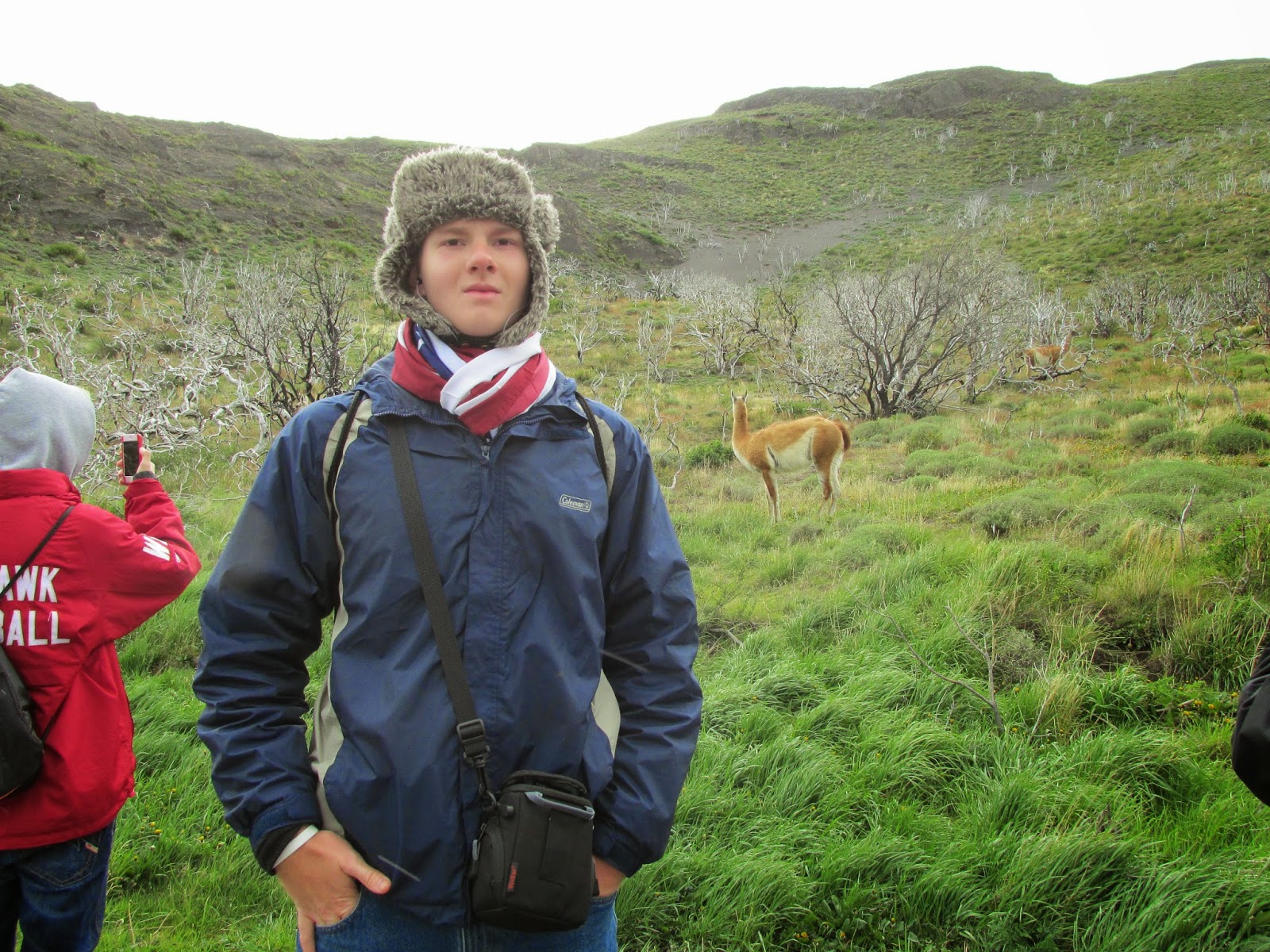
On the third day, we got up early, crossed the bridge, and began trekking towards the mountains. We walked for hours and hours through the most beautiful and most inhospitable place I've ever been. We passed packs of wild llamas (proper name: guanacos) and rheas. There were endless photo opportunities. I am almost reluctant to post photos, though, because they really do not do this place justice. I would hate to give you the wrong impression, but as I doubt any of you are planning a trip to Patagonia any time soon (you should), I'll go ahead and post some.
I don't like this picture, but it has a guanaco and it has me, so my mother will be appeased


The landscape was largely barren, but not just because of the relentless snow and wind. In 2011, a fire swept through a massive portion of the park. Today, the evidence is visible everywhere you look: the hills are spotted with charred, stunted trees and shrubs. The wind has since blown off a lot of the burned parts of the trees, revealing patches of white. It definitely gives the landscape an eerie touch.

Day 4: We needed to be at the bus and ready to go by 6:00. It was bitterly cold. We drove for a couple of hours before parking and hiking through the woods. From the shore of aptly-named Lake Grey, which was a cold gray and littered with icebergs, a little motor boat took us in groups to a bigger tour bout. After an hour in the boat, we came to a massive glacier. We floated around, taking photos, for an hour before heading back.

Glacier Grey. Massive

Shortly after arriving back at the hotel, I jumped into the lake with a few other students. As the Rotarians would say, it's good to experience new things and push your limits. I felt obliged to say that.

The week also included a trip to the Cave of the Milodon, a massive cave where remains of the milodon, a type of giant ground sloth, were unearthed. Apparently giant ground sloths lived everywhere between Patagonia and Northern Alaska, which I find impressive.

On the last day, we drove a couple of hours to a penguin reservation, which was home to a large penguin colony. Upon arrival, an attendant told us that a dog had found the colony and eaten "heaps of penguins." When most students voted to pay to enter anyway, he warned us that there seemed to be only five penguins left, but it was hard to count because none of them would leave their homes. We turned around and had some free time in Punta Arenas.

For the sake of not boring you, and for other reasons, I've left out a lot about this week. There was never a dull moment. I'm in my element while hiking and climbing, and I sure got a lot of that. I'm also closer with the other exchange students. November is often the most difficult month for exchange students, so I think this trip was something that everyone needed.


*The district is called Ultima Esperanza, which means last hope. The Spanish explorer Juan Ladrillero named it this because he tried to cross it, thinking it was his last chance to find what is now known as the Strait of Magellan. Instead of finding the strait, he found his way blocked by the largest non-polar ice field in the world. The glacier we went to is part of that ice field. 


Sunday, October 26, 2014

The South

I know I said I wouldn't do another blog post until after I return from Patagonia, but I think, with my trip last week, I would have too much to write about and end up posting a book. So I’m going to split it up.

For those of you who don't know, I just got back last night from a week-long school trip to Pucon, which is a village in the South of Chile. I finished all my laundry today and then packed it right back up. I've been home for just under 48 hours and I’ll be leaving again in just over 4 hours (at 2:45 in the morning). We’ll fly out of Santiago around 5:00 in the morning, and arrive in Punta Arenas around 10:00.

If Pucon is considered the south, then Punta Arenas is the South Pole. It is, in fact, the capital city of the Antarctica Chilena region of the country and is the largest city beneath the 46th parallel south. So in other words, it’s  pretty far South. Pucon was cold and rainy, and it’s not even halfway as far as Punta Arenas is from Santiago. 
I live in Santiago. Pucon is right in the middle, just above the words "Lake District." Punta Arenas is the city farthest to the south.
It was a twelve hour bus ride to La Ruca (The House), the lodge we stayed at. The country got wilder as we got further south. We pulled off the highway at around 7:30 and made our way south on smaller roads. The towns got smaller and farther in between. We went through nothing but dark fields for an hour or so before passing through a little town (which I would later learn was Pucon). After another half hour of woods and fields, we arrived. I stepped off the bus and was met by biting cold and a sky full of stars, more and clearer than I've ever seen.
La Ruca. The words say "Kom Che ni Ruka" (Native Language) and "Casa de Todos," which is Spanish for "House for All"


We had a brief introduction to the building and its caretakers before unloading the bus and settling into our rooms. We finished dinner at 11:00 then had some free time. I foolishly assumed that we would go to bed right afterwards. I quickly learned that Chileans seem to not need as much sleep as Americans do. We regularly had activities until 2:00 am and we needed to wake up at 7:00 or 7:30 every day. Our last night there we were up until 4:00 in the morning, and needed to wake up at 7:30 to clean our rooms and load the bus.

I made up for the lack of sleep and endless strenuous activities by eating an absurd amount of food. For breakfast all we had was bread and tea or coffee. I would start my day off with 7-10 pieces of bread for breakfast every morning. Sometimes more. I really needed the extra energy. I had less bread with lunch and dinner because there were actual entrees, usually some type of casserole or meat.

We did have one uncommon meal, however: Lamb. That might not seem very unusual, but it was prepared in a special way. We got back from one of the day's activities to find three big sheep tied up behind the lodge. Our director told us what was about to happen, and about half of the class went inside. I got out my camera. A man asked if anyone wanted to volunteer, and one of my classmates did. He was given a knife and told to slit one of the sheep's throats. Afterward, a man who I assume was the owner of the sheep hung the sheep upside-down from a tree and began to skin it. Another man killed the other two and then did the same thing. Then they were disemboweled. Two days later, we returned to the lodge to find the lambs being cooked over fires behind the lodge. They were delicious. I'll attach the photos at the end of my blog so that no one who doesn't want to see them has to.

This past week was packed with adventures. We climbed a mountain, rafted some intense white water, zip-lined, did a (very) high ropes course, spent time with a Mapuche (Native Chilean) farming family, and went to thermal pools heated by one of the 123 active volcanoes in Chile. I'll try to cover all of the bases briefly.

On our first full day in the South, we went for a hike. I wasn't sure what to expect, and I was unimpressed when we got off the bus and walked up a gently sloping hill for twenty minutes. What I didn't realize was that we weren't even on the trail yet. We arrived to the trail head and split into groups. The trail immediately got steeper and my legs were burning within five minutes. We rested for a bit at a little shelter, where the first of many good photo opportunities presented itself to me: a little fox came over for a visit. He was very interested in us, or at least in our food. I would have loved to take a photo, but I forget my camera on the bus, which was very frustrating because some of the sights were breathtaking.

It was a four and a half hour hike to the top. It got consistently colder as we rose, and the last third of the hike involved some very, very steep climbs (both hands and feet were necessary) and waist-deep snow. Only one third of the sixty or so people that started the hike made it to the summit.
Not where we climbed, just a nice view. To give you some perspective, we went much higher than this.

On the second day, we split into groups and went to Mapuche households. The group that I was in spent eight hours herding sheep and planting potatoes. The farmer that we worked with estimated that what we planted will yield 5,000 potatoes. My back is still sore.
The field that we planted.
There are lots of sheep in the South

The following day we did white water rafting. I've rafted several times before, but never like this. This was some intense white water (Class 4 or 5). Not to mention the water was frigid. I really can't believe we were allowed to do that on a school trip. It was a blast.

The next day we went to a high ropes and zip-lining course. It was a pretty park with some nice views. Personally, I think zip-lining is a little dull. Yes, we were up high, and that was fun, but each stretch of the eleven-part course lasted less than ten seconds. I preferred the high ropes course, which was challenging and exciting.

On our last full day, we went to the thermal pools, which were thoroughly disappointing. Imagine a run-down resort full of elderly people and foggy, lukewarm pools.


This past week was the most adventure-filled week of my life. But I will be spending the next week exploring one of the most beautiful places on earth, so Pucon might not hold the record for very long. I'll let you know.

WARNING: GRAPHIC CONTENT AHEAD

I left out the most graphic ones. You're welcome. This was part of the "Meet the Culture" Day, when we visited the Mapuche households. 


Step One: Wrangle up some sheep. One of my classmates sympathizing with the sheep.

Step two: I used the least graphic picture that I had.

Step three: Hang and clean. The sheep seen in the lower left-hand corner knew what was coming at this point.

Step four: Cook.

Step five: Try to forget about the previous steps and enjoy your meal.

Thursday, October 16, 2014

Two Months: Deadly Animals, a Hole in the Ozone Layer, and Eggs

             It's been a while since I've updated this. I write every day in Word, but the things that I write usually aren't worth copying over to this blog. It's been long enough now that I've accumulated enough semi-worthy scraps of writing to make a semi-decent post.

            This should be considered my two-month update, even though it's only day 54. I'll be out of town for the majority of the rest of October (tomorrow is my last day of school until November- and we get out at 12:30). I have two trips this month, one to the South of Chile with my school and then another to Patagonia with Rotary. I'll have two days of down-time between trips. I should have a lot to write about and a lot of pictures to post.

            It feels strange to have suddenly jumped from the youngest in the group to the oldest. I was always the youngest in my class and in my group of friends. Now that I’m in the Chilean equivalent to a junior class, I’m one of the oldest students, if not the oldest. There are only a few exchange students that are older than I am as well, as it’s not common to do a post-graduation exchange.

A friend told me that there are no deadly animals in Chile. There are no spiders that could kill a human. He said the worse they have here is the Chilean puma, and even those don’t attack humans. Coming from a country that is loaded with things that could kill you (Grizzly bears, rattle snakes, Outback Steakhouse), I was seriously skeptical. I need to look into that.

The results: My friend was more or less correct. There are no dangerous snakes in Chile. Apparently the worst that Chile has are the Brown Recluse and Black Widow spiders, the bites from which are very rarely fatal in humans. A bite from a Brown Recluse could cause kidney failure and necrosis around the bite, but it’s only fatal 3-4% of the time. A bite from a Black Widow can cause vomiting, muscle rigidity, severe pain, and sweating. Symptoms can persist from a few days to several weeks, but almost never result in human death, excluding in children or other weak bite victims. Anti-venom can be administered, but since the bite really isn't life threatening, it’s usually just for pain relief. Apparently it doesn't help much, according to Wikipedia.

Just last night, I found a Brown Recluse in my bedroom. After taking some pictures of it, I smashed it with a book called "The Exchange Student Survival Kit." I guess that title wasn't false advertising.


My host mother told me that the hole in the ozone layer affects Chile more than other countries. I didn't really believe that. Yes, it’s hot, so what. Well, after really feeling the sun burning me today, even through my clothes, even though it was only in the 60s, I looked into it. Turns out she was right. The hole in the ozone layer is directly above Antarctica, with little branches that reach out towards Chile and Australia. Areas under or close to the hole experience greatly increased levels of UV rays. Good thing sunblock is cheap.

Pomaire is a little village about an hour away from Santiago. It became an artisan village when it was discovered that there is abundant natural clay in the soil in and around the village. Today, while it is still small, Pomaire is a popular spot and is composed of very little more than street vendors and restaurants. Very fine quality pottery can be found all over the town and for very low prices, as it's all made right in the shops. Pomaire is known for its Chanchos, which are clay pigs that are supposed to bring good luck. They're often in bank-form. I bought a tiny one (the size of a dime) for my jacket.

While in Pomaire, I had a typical Chilean dish: Lomo a lo Pobre. It consisted of a massive steak, a mountain of French fries, fried onions, and all topped off with two fried eggs.
Lomo a lo Pobre

I had a similar meal last weekend at a sandwich shop that is owned by my host mother's brother when I ordered Chorrillano. It was a massive plate of (heavily salted) French fries topped with diced steak, grilled chicken, caramelized onions, sliced sausages, grilled peppers, and a fried egg. It was huge and absolutely delicious. Chorrillana originated in fishing villages, when fishermen would throw whatever they had together and call it a meal (when they got tired of fish, apparently). It was delicious. It is the kind of dish that you can eat once a year.

Eggs don’t need to be refrigerated here. I remember reading somewhere that in the U.S, eggs are power-washed to prevent salmonella, which could be present in the chicken coops, from entering the egg. This process removes a natural protective layer from the egg. The layer is basically the egg's immune system, and if left in the heat without it, the egg will spoil. Here, chickens are vaccinated so that salmonella can't be transferred to the eggs in the first place. The eggs are sold in stores on shelves with everything else or, if being sold from a vendor, sitting in the sun. There is also a wider variety of eggs here than in the U.S. Turkey eggs are commonly sold, along with eggs from much smaller birds. I noticed the turkey eggs for the first time when we went to Pomaire the other day. I saw more eggs in the mall today, including some small, spotted ones that were from the condorniz, or common quail.
Chicken, turkey, quail eggs in a supermarket near my house

Turkey eggs next to chicken eggs, Pomaire. You can see some pottery in the background. There's a lot of it.

 My classmate, Benjamin Tapia, told me the other day that he had read my blog. When I asked him which part, he told me that he had read all of it. He asked me to keep doing it. He also recognized that I had written about him in the part about black people. He seemed honored. In fact, he asked me to add a picture of him as an example of a Chilean black person.
Benjamin "Negro" Tapia

Pictured above is my good friend, Benjamin Tapia. Most people call him "Negro." While not exactly light-skinned, he wouldn't be called black in the United States. This is because there are very few black people in Chile (I wrote about that in much greater detail a few weeks ago- when Negro realized I was talking about him).

I probably won't post again for a couple of weeks (I probably wouldn't even if I didn't have two trips coming up), but in the mean time, if you'd like me to write about anything or have any questions, let me know.

Friday, September 26, 2014

School

People have told me that I should write about school. I realize that I have not written much about that subject even though it dominates most of my waking hours. So here we go:

I wake up at 6:15 each morning, prepare for the day, have breakfast, and leave for school, which starts at 8:00, at around 7:30. It’s a 20 minute drive to the school through some rough neighborhoods. It’s not uncommon to see gigantic piles of burning trash on the side of the road. My school is a very nice, modern building, though, and in a better part of town.

Most of my classes are an hour and a half long. They usually drag on. My professors talk very quickly. I would say that I understand less than half of what they say. But it’s getting better. The classroom environment is very laid back. Students and teachers have a very friendly relationship. It’s nice to see. The classes are very talkative. When I tell people that all of my classes in the U.S. were 45 minutes, they’re usually surprised and jealous.

Students can choose 1 of 3 fields of study: Science, Language, or Mathematics. I chose science. This means that I have more science classes than students in the other areas do. I have mixed feelings about that decision. Science is definitely my favorite subject, but when taken in another language it involves learning about 1,000 new vocab words. It’s difficult to follow.

 I have a different schedule every day. I have yet to totally figure it out (I carry my schedule around all day every day. I don't think anyone else does this. It's getting very tattered). A typical Thursday goes like this: “Oration”-15 minutes; Biology-90 minutes; 15 minute break; Math-90 minutes (this is a general math class, with algebra, geometry, and some pre-calculus. I also have an Algebra class); 15 minute break; Philosophy-90 minutes; Lunch break; History-45 minutes; Catholic Culture-90 minutes. We finish at 4:00 and  I get home at around 4:45.

Math is probably my easiest class, as what we’re learning now I learned four years ago (although this makes it hard to remember) and math is a universal language.

There’s a very lax attitude about swearing and dirty humor. Students swear loudly in class, and the professors usually don’t say anything (unless it’s “shut up,” which is very common). The same goes for dirty jokes.

On a similar note, there are a couple of darker skinned people in my class. They would be called “white” in the U.S, but here people call them “Negro” in a friendly way. This is because there are very few black people in Chile (I think the only ones I’ve seen so far were at the airport or at the International Police, registering like I had to). Apparently it’s not offensive. I’m often called “El Gringo.” I’m not offended by this, as no one has said it to me in a derogatory manner, although I have had some people check to make sure that it doesn't bother me. So I suppose it could be considered offensive. But it doesn’t bother me. My classmates are all very nice.

The last day of school is December 11th, when summer break starts. I feel lucky that I’ll get to spend a summer here. All of the students that go to a country in the Northern Hemisphere arrive around the time school starts and leave when school ends.